Week 1
My online activities
I use the internet for lots of different things. Most of the time I am spending online, I participate on social media platforms. I use Whatsapp during the whole day to stay in contact with my friends, family, roommates, sports team and work. I also use Instagram, just for fun. I also have an Facebook-account, but I am not using this actively.
Besides this I also use the internet as my biggest news sourch. I check nos.nl for the latest news updates, but also use twitter to stay updated. I prefer twitter, because it shows more opinions and personal stories according though public discussions.
Since this week I am also learning Spanish on the Internet.
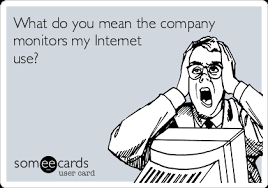
My image
Week 2
My meme
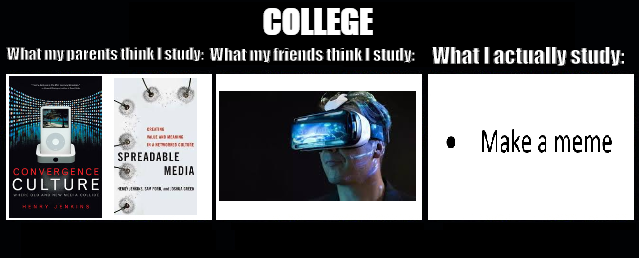
For this meme I used an already made format, which I re-created according to my own interests. This format is about expectations of others, like family, friends and society, related to the reality. The memes mainly show assumptions about hobbies, jobs or subcultures. Most of the time this kind of meme exists of six pictures and situations, but in my case, I have reduced it to three.
The origin of this meme can be found on Facebook, where for the first time someone made this kind of meme in relation to the expectations and assumptions of contemporary artists.
This kind of meme can be seen as culturally meaningful because the images confront the spectator with assumptions and expectations which dominate our society. The memes show different stereotypes, but at the same time these stereotypes are broken down.
My questions about the texts
Virginia Kuhn – “The rhetoric of remix”
How do remix videos gauge the velacity of the information presented by all the media?
Asaf Nissenbaum – “Internet memes as contested cultural capital: The case of 4chan’s /b/ board”
According to Milner’s idea about “right” and “wrong” memes, how can we decide if memes are right or wrong?
Henry Jenkins, Sam Ford and Joshua Green – “Introduction: Why Media Spreads”
According to this citation: “For instance, the Susan Boyle video was widely shared because the participating public is more collectively and individually literate about social networking online?” How can the public be more individually as well as collectively literate about social networking online?
Kate Miltner and Tim Highfield – “Never Gonna GIF You Up: Analyzing the Cultural Significance of the Animated GIF”
How does the endless looping repetition contributes to the relaying of multiple levels of meaning in a single GIF?
Week 3
My questions about the texts
To what extend can watching vids be seen as a participatory practice?
To what extend can Jenkins’ text be seen as an objective one, mentioning that he explicitily says in his text about fandom that he is a fan himself?
What is the difference between the two concepts Adrienne Shaw mentions in her part of the text, margins and perifphery?
Week 4
My questions about the texts
What are the requirements to use online data as data for your research?
In the text the author applies the discourse analysis on a political speech. To what extent does the analysis on this case study differs from an analysis on an online community?
To what extent can antifans be seen as active participants?
To what extent contribute images to a discourse analysis, which is in my opinion more focused on language?
Week 5
My questions about the texts
Why do online social movement leaders want to stay anonymous while traditional social movement leaders wouldn’t?
“But at the same time, these forums are highly exclusionary at the level of rhetoric and access, which pushes them outside the realm of the democratic.” How does this exclusion, mentioned by Nico Carpentier works?
Why is it difficult to avoid the conclusion that the politics of the text are thoroughly reactionary, when you choose to approach the storyworld from the perspective that narrative closure is decisive when interprting a text’s ideological meaning?
Week 6
My questions about the texts
“The Ukrainian government’s utilization of unpaid and externally compensated digital labor is made possible by a confluence of economic, discursive, and technological factors.” What are these factors?
“Since the start of the Wikipedia project in 2001, the dedication of its contributors, as well as the group effort as an alternative to the professional expert approach, have been sources of both excitement and criticism.” What is this excitement and criticism about?
“… innovation communities, or whatever the nomenclature – existed prior to the arrival of the web, as Surowiecki (2004) notes throughout his book.” Can a form of crowd sourching exists offline, without the interet?
My findings on Wikipedia
For this exercise I analyzed the discussion section of the Wikipedia page of Michael Jackson. The participants on this section, discuss different kinds of aspects. Mostly, the truthfulness of facts is discussed. There is a big discussion on the dead of Michael Jackson on the time he died. The participants were sharing sources about his dead. After some discussion they find the right sources which showed when he actual died. The relevance of information is also something which is talked about on the page. The participants exclude rumors and favor information based on sources. Besides this the participants discuss the neutrality of the text. The discussion shows that neutrality in relation to this music artist is important. The lay out of the page is also a topic on the discussion section.
Week 7
My questions about the texts
Are active participatory children a product of the digital age, or did this active behaviour on a young age exist before in different way?
To what extend differs education in media literacy for migrants from education in media literacy for non-migrants?
 Participatory Culture