Week 1: Participatory cultures
My Online Activities
I don’t use a lot of social media platforms. I for instance do not have an Instagram or a Twitter account. I do have a Facebook account that i use to keep in contact with my friends, but i do not post any message’s of my own. I only like and comment on other posts. I’m on Facebook daily, checking things i, for instance, been tagged in or checking up on upcoming events. Another social media platform i use daily is Snapchat. I use this platform to send funny or interesting pictures to my friends to keep them up to date. This is one of my favorite platforms because it is easy to just send a quick picture a couple people will only see for a couple of seconds.
The platform i use the most is Whatsapp. I’m on this platform almost every couple of hours or when i open my phone. This is the main platform for sending and receving messages and is very usefull to me.
The last two platforms i only use to check out things other people post. These platforms are Pinterest and Youtube. I look at Pinterest for pictures for inspiration about all sorts of things. I’m not on this website a lot. I’m on Youtube a lot, almost daily, looking at video’s from Youtuber’s i’m subscribed to. I watch all kind of video’s that interest me.
These are the main platforms i use online

Week 2: Spreadable media
Memes
Questions about the text:
-“The rhetoric of remix,” by Kuhn, Virginia:
What does Walter Ong mean by second orality?
-“Internet memes as contested cultural capital: The case of 4chan’s /b/ board,” by Nissenbaum, Asaf and Limor Shifman:
Nissenbaum and Shifman talk about the interplay of disparity and similarty, what does this mean and how does this differentiate a meme from a meme instance?
-“Introduction: Why Media Spreads,” by Jenkins, Henry, Sam Ford and Joshua Green:
How does ‘destination viewing’ conflict with the dynamic browsing experience of viewers and with the circulation of content.
My meme:
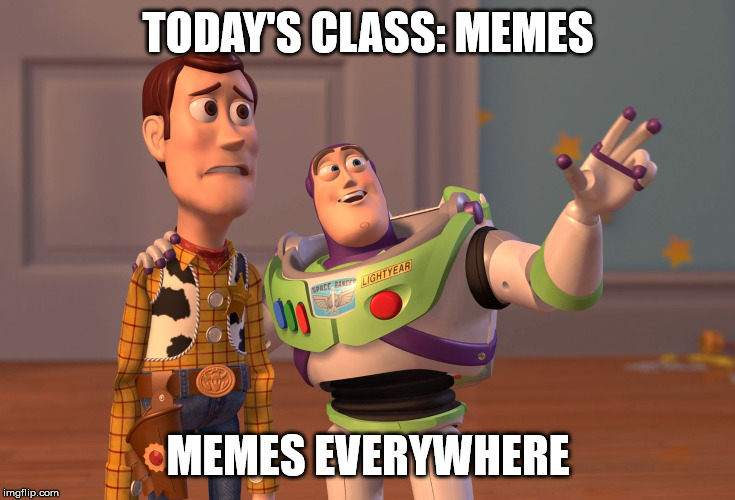
The orgin of this meme:
The meme X, X Everywhere (where the X is whatever the person wants to fill in) is used for a lot of different cultural references. It started to be used in 2007 on 420chan imageboard. When one of the site administrators carried out a worldfilter that would automatically fill in any text-less image post with the phrase ”Dicks Everywhere.” People soon started to replace “Dicks” with a word that they found more relevant to the image.
The sentence X, X Everywhere has uncertain originins. The earliest use of the phrase can be found in part two of The Rime of the Ancient Mariner, written by English poet Samuel Taylor Coleridge and first published in 1798. Namely:
“Water, water, everywhere,
And all the boards did shrink;
Water, water, everywhere,
Nor any drop to drink.”
The image behind the text was taken from Toy Story 2. This image is form a scene inside Andy’s house, when Woody lost his hat and Buzz tells him that in a couple hours it will al be fine and they will be sitting around a campfire enjoying smores.
I used this meme to refer to today’s class. Because this is the topic of today. Everyone had to make a meme and will want to show it to eachother and that is why there will be meme’s everywhere.

Peanut Butter Baby is a viral video featuring footage of a young baby boy seated on top of a table completely covered in peanut butter. It was reuploaded on Vine in 2015, it has inspired numerous remixes on the video sharing site.
On January 24th, 2009, Facebook user Gina Gardner Brown uploaded footage of her daughter Emily covering her baby brother Ethan’s entire body in peanut butter. According to the description, the video was recorded in 2004.
I used this gif because in the text spreadable media was compared to spreading peanut butter. And this baby is covered in peanut butter.
Week 3: Fan Culture
Questions about the text:
-Jenkins, Henry. 1992. “”Get a Life!:” Fans, Poachers and Nomads.” In Textual Poachers. New York: Routledge. 9-50:
How objective is the text considering Jenkins is a fan himself?
-Turk, Tisha and Joshua Johnson. 2012. “Toward an Ecology of Vidding.” In “Fan/Remix Video,” edited by Francesca Coppa and Julie Levin Russo, special issue, Transformative Works and Cultures 9 https://doi.org/10.3983/twc.2012.032
How does the ecology of vidding build upon the ecology of writing?
-Banet-Weiser, Sarah et al. 2014. “Participations: Dialogues on the Participatory Promise of Contemporary Culture and Politics. Part 1: Creativity.” International Journal of Communication 8: 1069–1088:
Adrianna Shaw talks about a dichotomy between commercial and grassroots production, what does this mean?
Week 4: Virtual Ethnography
Questions about the text:
-Hine, Christine. 2015. “The Internet in Ethnographies of the Everyday.” Ethnography for the Internet: Embedded, Embodied and Everyday. London: Bloomsburg. 157-179:
Hine says that “non-reactive research methods are very useful where it may be difficult for respondents to give honest or authentic answers about their behavior” but how honest are the reactions of people online? Don’t they often portrait a character that they may not show in interviews?
-Gray, Jonathan. 2005. “Antifandom and the Moral Text.” American Behavioral Scientist 48(7): 840-858.
How can sarcastic comments fit in the analysis of the antifan?
-Helsmondhalgh, David. 2006. “Discourse Analysis and Content Analysis.” In Analyzing Media Texts, edited by Marie Gillespie and Jason Toynbee. New York: Open University. 119-156.
Helsmondhalgh says that quantative such as content analysis are useful and important to media studies, however we have always been thought not to do quantative analyses. So how can we interpret this?
-Schneider, Florian. 2013. “How to do a Discourse Analysis”. Web. http://www.politicseastasia.com/studying/how-to-do-a-discourse-analysis/
To which extent do we have to use the establishment of context and the exploration of the production process in the actual research?
Week 5: Activism and political change
Questions about the text:
-Poell, Thomas & José van Dijck. 2017. “Social media and new protest movements.” In The SAGE Handbook of Social Media. Edited by Jean Burgess, Alice Marwick & Thomas Poell. London: Sage. 546-561. https://papers.ssrn.com/sol3/papers.cfm?abstract_id=3091639:
“New social movements revolve around both solidarity and individuality,” what does the text mean by this?
-Hassler-Forest, Dan. 2016. “The Hunger Games” In Science Fiction, Fantasy, and Politics: Transmedia World-Building Beyond Capitalism. London: Rowman & Littlefield. 135-150:
What does “a lack of specificity in The Hunger Games political allegory” mean?
-Allen, Danielle et al. 2014. “Participations: Dialogues on the Participatory Promise of Contemporary Culture and Politics. Part 3: Politics.” International Journal of Communication 8: 1129–1151:
Schaffer describes implicit participation, what is the line between implicit participation and non-participation?
Week 6: Cultures of knowledge
Questions about the text:
-Sienkiewicz, Matt. 2015. “Open BUK: Digital Labor, Media Investigation and the Ukrainian Civil War.” Critical Studies in Media Communication 32 (3): 208-223:
Sienkiewicz talks about ‘hope labor,’ but how is this measurable in practice?
-Niederer, Sabine and José van Dijck. “Wisdom of the crowd or technicity of content? Wikipedia as a sociotechnical system.” New Media & Society 12(8): 1368–1387:
How open and collaborative is Wikipedia considering there are different permission levels?
-Brabham, Daren C. 2008. “Concepts, Theories and Cases of Crowdsourcing as a Model for Problem Solving: An Introduction and Cases.” Convergence 14 (1): 75-90
“Given that users spread throughout a geographical terrain, among a variety of cultural backgrounds, the web can facilitate the exchange of diverse opinions,” how diverse are the opinions in actuality, because there are always people who do not have acces to the internet?
Wikipedia discussion:
I looked at the Wikipedia page for the Brexit. There is a lot of discussion, mostly about the neutrality of people posting and editing the page. Which is one of the main things Wikipedia advocades. So are pro and non-pro comments on leaving left out.
One user also talks about the debth of the page. He says that there are only numbers and nothing about the underlying issues. But this might not work with NPOV.
Some comments are also about speculation. About what will happen if England leaves the EU, which is not considered as facts and cannot be put on the page.
Week 7: Critical media literacy through making media
Questions about the text:
-Jenkins, Henry. 2006. “Why Heather Can Write.” Convergence Culture: Where Old and New Media Collide. New York: New York University Press. 169-205:
When does someone actually participate with for example the Harry Potter world?
-Leurs, Koen, Ena Omerović, Hemmo Bruinenberg and Sanne Sprenger. 2018. “Critical media literacy through making media: A key to participation for young migrants?” Communications 43(3): 427-450. https://www.degruyter.com/downloadpdf/j/commun.2018.43.issue-3/commun-2018-0017/commun-2018-0017.xml:
How was the imigrants media literacy before the days of social media?
 Participatory Culture