My online activities:
Over the last few years my online practices have decreased a little. Today I mainly use social media platforms like Instagram, Facebook and Snapchat for personal content. The platforms I use the most often are Instagram and Whatsapp. On here I post about my life and like to send cat videos and memes to my friends, interact with people I know and keep up to date with content that I like.
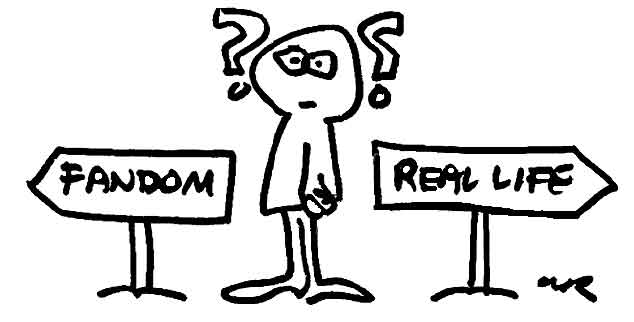
A few years ago I was very active in fan communities on Tumblr and Twitter. On my accounts I posted content focusing on Marvel movies, a lot of different television shows, books and sometimes art I made in relation to these things. Through this I met fans from all over the world and even interacted with a few creators of the works I posted about. Because of a lack of time and a loss of interst in some of the content I posted about, I stopped posting on most of my accounts. Today I am still really interested in the practices of fans on the internet and regularly search the hashtags I used to frequent when I still posted on my fanaccount to see what has changed.
Questions about the week 2 literature:
–“Introduction: Why Media Spreads” in Spreadable Media by Henry Jenkins, Sam Ford and Joshua Green: How does the idea of how audiences pass material along counter the metaphor of infection that the concept of “viral” invokes?
–“The rhetoric of remix,” by Virginia Kuhn: What is the exact relation between the Greek writers and the argument of this article?
-“Internet memes as contested cultural capital: The case of 4chan’s /b/ board,” by Asaf Nissenbaum and Limor Shifman: How do memes, when used as a discursive weapon, justify judgement?
My Meme:
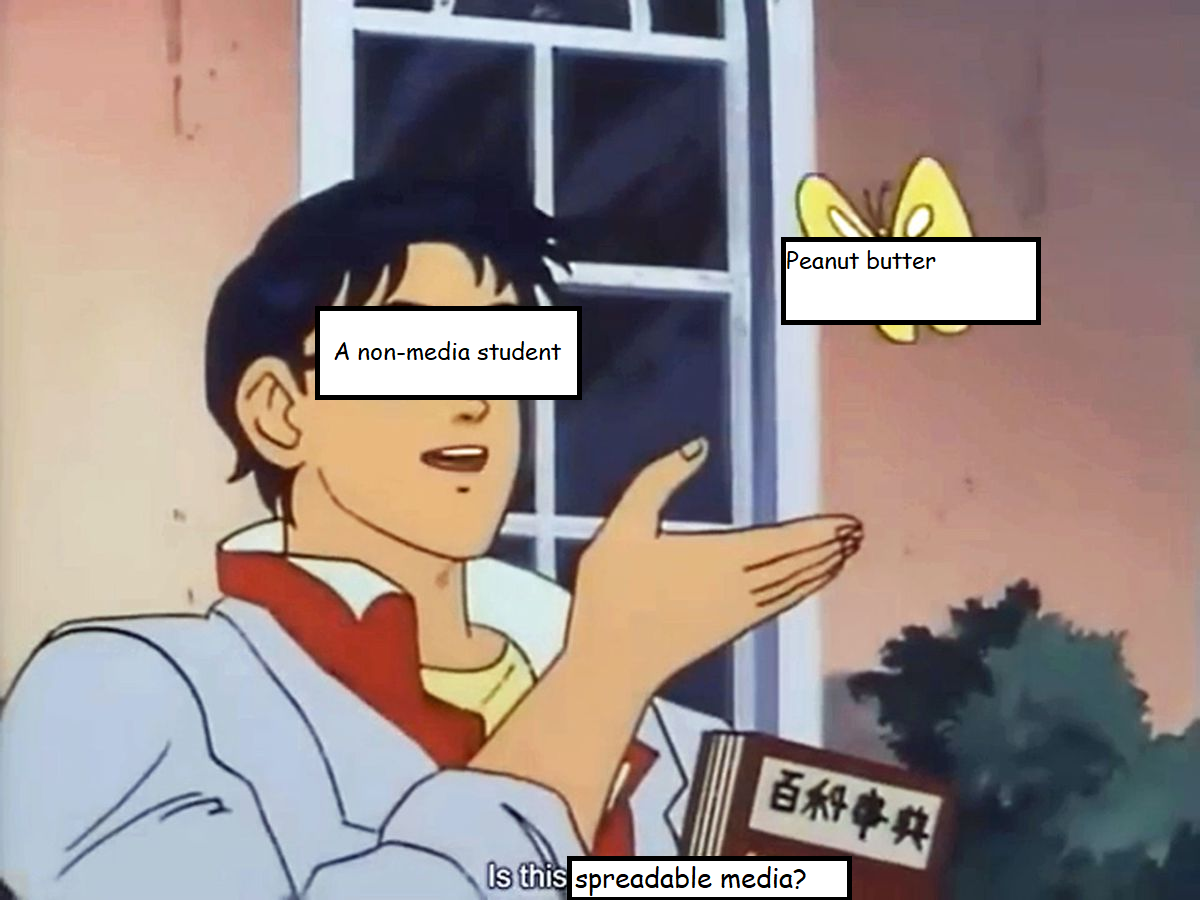
This meme is called “Is this a pigeon?” The origin of this meme is a memorable quote said by the protagonist character Yutaro Katori, a human android, from the 1990s Japanese anime TV series The Brave Fighter of Sun Fighbird. He misidentifies a butterfly as a pigeon while studying the earthly nature. On Tumblr, the quote, along with a reaction image of the scene featuring the English-translated subtitle, is widely used to express utter confusion.
One can find the social relevance of this meme in it’s ability to critique culture. Groups of people can express themselves by critiquing wrong interpretations of for example seemingly common concepts in their field of study (as I did here) or common sense.
Questions about the week 3 literature:
–Jenkins, Henry. ”Get a Life!:” Fans, Poachers and Nomads.” In Textual Poachers, 1992. New York: Routledge. 9-50:
To what extent is this chapter by Henry Jenkins still applicable to today’s fan culture in which the stereotypes of a fan Jenkins mentions are slowly fading?
–Turk, Tisha and Joshua Johnson. “Toward an Ecology of Vidding.” In “Fan/Remix Video,” edited by Francesca Coppa and Julie Levin Russo, special issue, Transformative Works and Cultures 9 (2012):
What can be considered as an example of a call up for fans specific conversations, interactions, emotions, relationship developments, or plot points after seeing clips in fan videos?
–Banet-Weiser, Sarah et al.“Participations: Dialogues on the Participatory Promise of Contemporary Culture and Politics. Part 1: Creativity.” International Journal of Communication 8 (2014): 1069–1088:
At multiple points in the article the writers mention the dichotomy between commercial and grassroots production being considered too easy. In what way is this the case?
Questions about the week 4 literature:
Gray, Jonathan. 2005. “Antifandom and the Moral Text”: When Gray references Bird he mentions that we need to stop thinking of a text as ‘located.’ What would be another concept to use in its place?
Helsmondhalgh, David. 2006. “Discourse Analysis and Content Analysis”: Why is the term positivist seen as a dismissive term?
Hine, Christine. 2015. “The Internet in Ethnographies of the Everyday”: In what way does this method differ and resemble the methods described by David Helsmondhalgh?
Schneider, Florian. 2013. “How to do a Discourse Analysis”: One of the steps Schneider defines is ‘coding.’ Is there an example of another concept to define this method of categorising with? (as I find this concept to be quite vague when using the word ‘code.’)
Questions about the week 5 literature
- Poell, Thomas & José van Dijck. 2017. “Social media and new protest movements:” How can the choice of connective leaders of social media protests to remain anonymous be seen in relation to an online protest in which many of the participants can be anonymous because of the affordances of social media?
- Hassler-Forest, Dan. 2016. “The Hunger Games:” How can Vimo’s concept ‘virtuosity’ be recognized in the transmedia marketing of The Hunger Games and did it contribute to fan activism?
- Allen, Danielle et al. 2014. “Participations: Dialogues on the Participatory Promise of Contemporary Culture and Politics. Part 3: Politics:” Carpentier answers Moya’s question “Is participation reactionary?” and states that at some point it stops being participation. What can be seen as the boundary between participation and nonparticipation?
Questions about the week 6 literature
–Sienkiewicz, Matt. 2015. “Open BUK: Digital Labor, Media Investigation and the Ukrainian Civil War.”:
How does ‘hope labor’ differ from ‘free labor’?
–Niederer, Sabine and José van Dijck. “Wisdom of the crowd or technicity of content? Wikipedia as a sociotechnical system.” :
How does the use of bots influence our vision of the concept of ‘collective wisdom’?
–Brabham, Daren C. 2008. “Concepts, Theories and Cases of Crowdsourcing as a Model for Problem Solving: An Introduction and Cases.”:
Why is Lévy considered too utopian in his vision of a society? Couldn’t the characteristics he mentions still appear while creating hipster t-shirts?
Wikipedia Discussion:
When looking at the Wikipedia page for Captain Marvel (film), one can see that there is an ongoing discussion concerning the modification of the review bombing statement on the talk board. Multiple Wikipedia users are discussing editing the content and adding a new source. The user that requested this change argues that the wording as of that moment was inaccurate and they wanted to use the source ‘RedState’ to validate the new claim. Multiple users argue against the use of this particular source as it is a subjective news article. Users try to suggest other sources to use for this claim and also suggest other ways to word the sentence. Eventually the editors seemed to agree on making a change from ‘perceived feminism’ to ‘activism.’ However this change doesn’t show on the page. Eventually one could conclude that editors added new sources to this part of the page and substantiated the claim by adding some new information.
Questions about the week 7 literature
–Jenkins, Henry. 2006. “Why Heather Can Write.” Convergence Culture: Where Old and New Media Collide. New York: New York University Press. 169-205: Why is it striking that the educational process is taking place outside of the classroom? Isn’t it more common that people learn from eachother?
–Leurs, Koen, Ena Omerović, Hemmo Bruinenberg and Sanne Sprenger. 2018. “Critical media literacy through making media: A key to participation for young migrants?” : How does the education in media literacy of migrants differ from the education in this for non-migrants?
 Participatory Culture